
A good preparation for surgery starts at home
Healthcare in the Netherlands is among the best in the world. We want to keep this high-quality care accessible in the future as well. Coöperatie VGZ believes this is possible by working together with healthcare professionals on sensible care. They know better than anyone what is best for the patient.
An increasing number of healthcare professionals are showing us great initiatives of meaningful care. Successful initiatives that lead to better patient care, smart deployment of scarce healthcare personnel, and more accessible care. An example of this is (digital) preoperative screening (E-POS)*.
60 to 70% fewer outpatient consultations
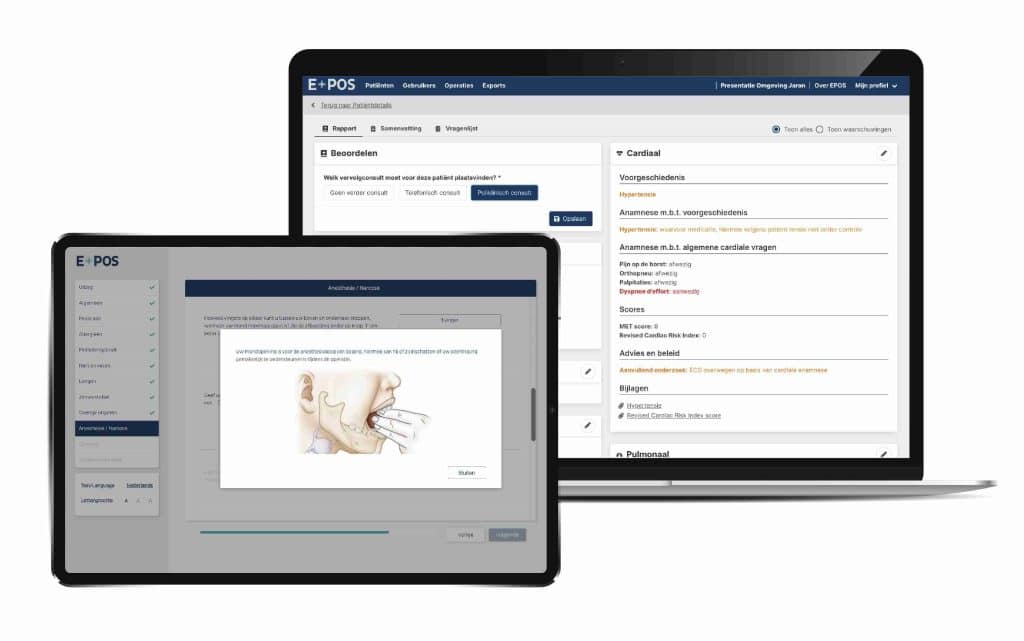
Through the E-POS web application, developed by NovaCair, preoperative screening is performed digitally and remotely. During a preoperative screening, patients are normally physically assessed at the anesthesiology outpatient clinic in preparation for surgery. With the help of E-POS, this is now largely done digitally and remotely. The initial results of E-POS are promising. Due to the implementation of E-POS, there are 60 to 70% fewer physical consultations**.
How does E-POS work?
In preparation for surgery, the patient digitally completes a questionnaire. Based on the answers, an advisory document is automatically generated using international guidelines. In addition, E-POS contains a triage system, which results in one of the following recommendations: whether the patient is suitable for digital approval, needs to be called back by the physician, or needs to come to the hospital. The app also includes several animations explaining the operation, lifestyle rules, and anesthesia options to the patient. The app only displays personalized information to the patient, eliminating the need for them to search for information.
Patients can prepare for surgery from the comfort of their own home environment
E-POS offers patients freedom and self-management. Patients can decide for themselves when to review the information and look back at it whenever they wish. This gives them the opportunity to discuss any questions with their family and friends. Research shows that information is better retained in the patient's home environment. Patients also do not have to visit the hospital unnecessarily. They can prepare for their surgery at home using clear instructions.
Through the E-POS advisory document, the anesthesiologist gains better insight into the patient's health status. As a result, they enter consultations with complex patients much better prepared. Because the information from E-POS is available to all medical specialists involved, a more consistent assessment of the patient will also be formed. This allows them to organize consultations more efficiently in the long term. Appointment times can then be scheduled based on the patient's health and needs.
Rik Bijl, NovaCair: "The major difference between E-POS and other systems is that we work with a validated triage system. E-POS also provides a concrete and well-considered advisory document for the anesthesiologist. This refers to the guidelines and can also be used for the patient file.”
E-POS at Dijklander Hospital
Dijklander Hospital started using E-POS at the end of March. The initial pilot results are very positive. Already 1,600 patients have been screened using E-POS, and by July, 36% of patients were immediately approved for surgery by E-POS. Because Dijklander Hospital is still in a pilot phase, all patients are called back until September 1. After that, patients will be directly approved via E-POS. Discussions are currently underway to integrate E-POS with the electronic health record. In the future, Dijklander and NovaCair also want to advise patients on preoperative activities, such as stopping medication or fasting, making preoperative care increasingly safer.
John van Roy, anesthesiologist at Dijklander Hospital: “E-POS is the textbook example of meaningful care. It offers the patient freedom and control. E-POS gives the specialist more insight into the patient's health status. This makes it possible to distinguish between healthy and less complex patients. This ensures that as a specialist, you can focus your attention on the patients who truly need it.”
The initial reactions from Dijklander Hospital patients are also very positive. They find the instructions informative and clear. Patients have no additional questions for the specialist, which indicates the completeness of the information in E-POS.
Accelerating scaling by sharing experiences
E-POS has accelerated due to COVID-19. Many hospitals are now accelerating their transition to digital care and are eager to start using E-POS. NovaCair has seen the number of requests for E-POS double in the recent period. In addition to anesthesiology, there is also a growing interest in the app from other specialties, such as surgery. By the end of next year, NovaCair aims to have E-POS implemented in 15 to 20 hospitals. Dijklander Hospital has also shared its experiences with E-POS with other hospitals in the meaningful care network (Netwerk zinnige zorg). E-POS has also been deployed at Elisabeth Tweesteden Hospital (ETZ) since July 1. Noordwest Ziekenhuisgroep is in talks with NovaCair regarding the implementation of E-POS.
E-POS will be the new normal in 5 years
Specialists indicate that visiting the hospital is not always necessary for quality care. By applying smart technology, high-quality care and its preparation can also be delivered at home. By determining in advance what the added value is for the patient to visit the hospital, the specialist can assess whether the appointment can also be conducted digitally. This approach allows appointments to be scheduled much more efficiently. This mindset will ensure that healthcare looks very different in 5 years.
John van Roy, anesthesiologist at Dijklander Hospital, can recommend E-POS to any specialist. “E-POS allows us to work much more standardly and better demonstrate our added value as specialists. Consequently, we can make an impact where it is needed and optimize our time. This enables us to optimally prepare patients for a procedure and reduce risks.”
*This initiative aligns with the professional framework issued by the Dutch Society for Anesthesiology 2019.
** This percentage is based on the non-academic population.